

An Individual World Player
GH on the importance of Sir Garfield Sobers

An article first published in Wisden Asia Cricket magazine in 2002.
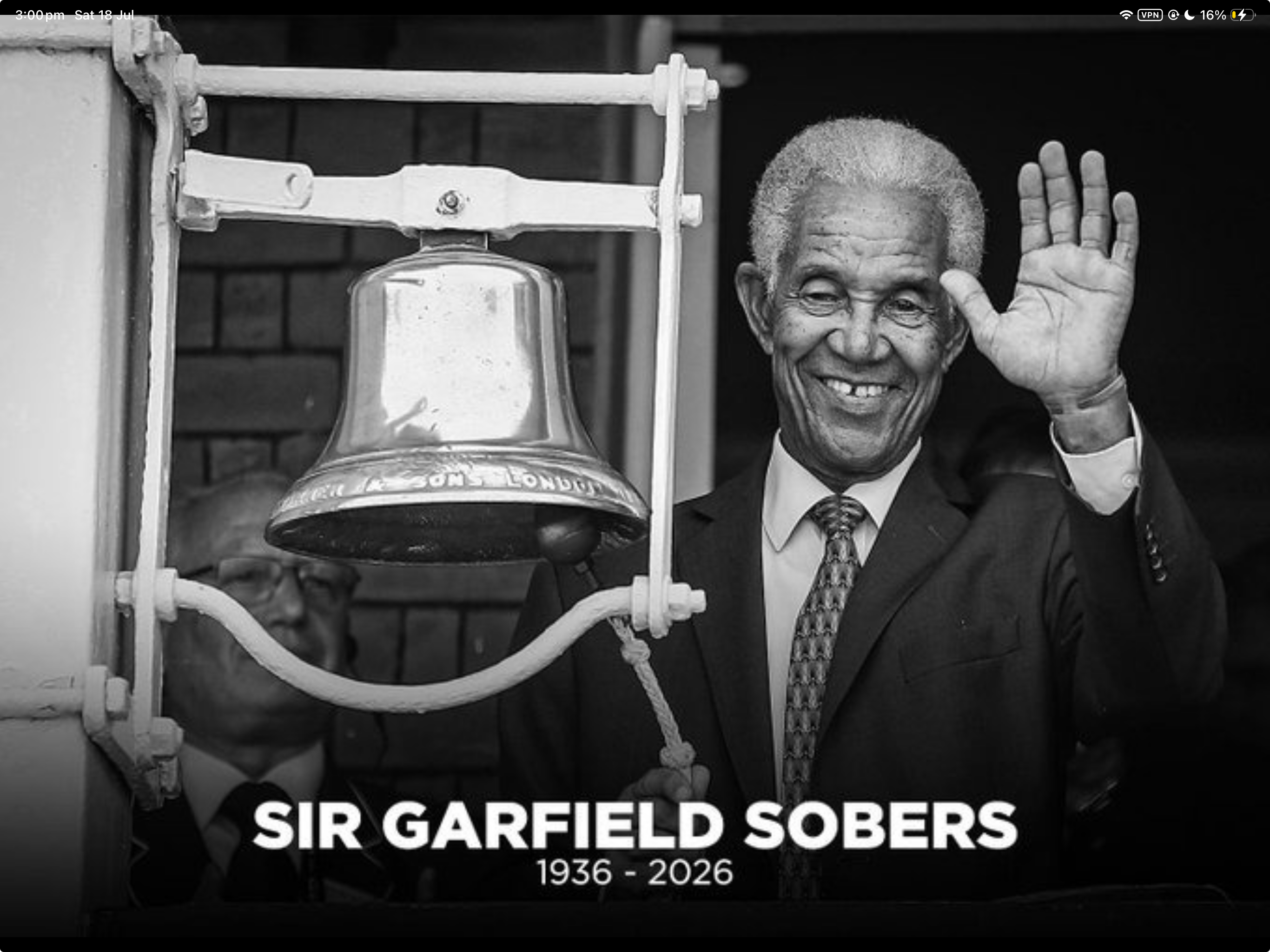
In Cricket In The Leagues, John Kay describes a match in which Garry Sobers represented Norton and was hit back over his head. Sobers reportedly turned, ran towards the boundary shouting “leave it to me” and took the catch just in front of the sightscreen.
“Leave it to me” - and you could. To Ray Robinson, Sobers was “evolution’s ultimate specimen in cricketers”. He combined faculties of the game as no other, batting from one to nine in the West Indies order, bowling every variety of left-arm delivery, fielding in every position with uniform excellence and captaining with a knowledge that his predecessor Frank Worrell described as encompassing “everything” - this for two decades, with only the barest attenuation in performance as age encroached. Incorporate Sobers’ matches leading world XIs and his international record stretches from horizon to horizon: almost 9000 runs at 58, 265 wickets at 33, and 121 catches.
All this was accomplished, furthermore, with a unique elasticity and elan. Of his batting Barry Richards once observed that Sobers was “the only 360-degree player in the game”; that is, his follow-through ended where his pick-up began, swinging “right through every degree on the compass”. The generosity of swing was matched by a generosity of spirit, for Sobers was also a walker throughout his career - not only a mark of sportsmanship but indicative of a confidence in his abilities that needed no help from luck. And one notes of his bowling that, despite operating under front- and back-foot laws, he bowled only a handful of no-balls in his entire career. Such was his instinctive feeling for cricket’s calibrations.
In the post-colonial West Indies, not surprisingly, Sobers was a point of pride, almost a divine. CLR James - and none wrote better of Sobers than James - saw in him “the living embodiment of centuries of tortured history”, and “a West Indian cricketer, not merely a cricketer from the West Indies”.
The appointment of Worrell to lead West Indies to Australia in 1960-61 is generally regarded as the defining moment in Caribbean cricket. But, as Brian Stoddart suggests in Liberation Cricket: West Indies Cricket Culture, Sobers’ succession, taken on the field in March 1965, was “the real break with the past”. Worrell was courtly, tactful, educated at an English university, a Freemason; Sobers’ background was both indigenous and indigent. He was raised by a widow in a small shack in Bridgetown’s Bay Land, a tenantry created for plantation workers after the cessation of slavery in 1838. Between docks that were a crucible of industrial dispute and a local cricket club for whites only. His rise from exclusion to eminence, Hilary Beckles contends in The Development of West Indies Cricket, sent “a signal of hope for collective redemption”.
In some senses, however, Sobers was an awkward hero in the cause of West Indian self-affirmation through sport. He did not view defeat in a Test as setting back the struggle for national prestige: “Cricketers are entertainers”, he said, when he scandalised fellow countrymen with his costly declaration in Trinidad in 1967-68.
He was awkwardly apolitical too. He explained his controversial visit to Rhodesia for a double-wicket competition in September 1970 by saying he “knew nothing of politics at the time”. His avowal that “there should be no barriers in sport” smacked of an apology for sporting contact with South Africa. (Sobers, in fact, makes clear in The Changing Face of Cricket that he did not play in South Africa himself only because he had “had my fill of publicity and criticism” during the Rhodesian affair; it had “nothing to do with what was happening in the country”.)
He was raised by a widow in a small shack in Bridgetown’s Bay Land, a tenantry created for plantation workers after the cessation of slavery in 1838. Between docks that were a crucible of industrial dispute and a local cricket club for whites only. His rise from exclusion to eminence sent a signal of hope for collective redemption
He was as slow to militancy as some of his successors were quick. It is interesting, for example, to contrast Sobers’ and Viv Richards’ responses to Tony Greig’s vow to make the 1976 West Indians “grovel”. In Hitting Across The Line, Richards recalls it as a “racist dig”, which “gave strength to a lot of the West Indian guys”. In Twenty Years At The Top, Sobers dismisses it as a throwaway line.
On the face of it, then, there is a tension here. Sobers was, for many fellow countrymen, a cultural embodiment. Yet he could appear remote, removed from dimensions of that culture. Why? It may be instructive to consider one of the most intriguing events in West Indian cricket history - or, to be precise, non-events, for ultimately it did not happen.
After his first few years in Test cricket Sobers followed the well-trodden route of many West Indians into the English leagues, representing Radcliffe in the Central Lancashire League from 1958 to 1962. After his feats in 1960-61 he was also lured to South Australia for three seasons, inspiring their first Sheffield Shield win in a decade. “My kind of cricket is world cricket,” he explained breezily in Cricket Crusader. “And the jet plane makes all-year-round cricket possible for the individual world player.”
It was as an “individual world player” representing South Australia that, in early 1963, the invitation from the West Indies board to tour England found him. The tour fee, a derisory £800, irked Sobers: he could earn far more in a summer of one-day-a-week league cricket. He equivocated, discussing the tour with Donald Bradman and Richie Benaud. Both urged him to go, although Bradman agreed that “with your standing you should get more money than anyone in the game”, and Sobers remained ambivalent. What finally persuaded him was a strongly worded letter from Worrell reminding him of his patriotic duty.
Keep reading with a 7-day free trial
Subscribe to Cricket Et Al to keep reading this post and get 7 days of free access to the full post archives.