

Firefinisher
GH on Ben Stokes


Ben Stokes, as they say, left nothing out there as a cricketer. Can anyone have spent themselves so completely in a team’s cause, bent their body till it broke time and again, led more red-bloodedly and red-facedly in endeavours he retrieved from the verge of futility? He was, perhaps, England’s fullest all-round cricketer, in that he succeeded in all faculties of the game including captaincy, as even Ian Botham and Andrew Flintoff did not.
Nothing, too, is what it feels like he has left for English cricket. Great memories, great times, all that. But how stands his team today? They are almost certain to lose their first home series since 2012. Their captain is effectively out of the match on the last day of his international career; their vice-captain is out too, having got caught up in the contagious self-immolation. The atmosphere was amazing, they say, as he dismissed….Zac Foulkes? There was a great vibe at the Charge of the Light Brigade too.
As for the England Cricket Board, Stokes has done a Samson, bringing the temple down round their ears. It had been teetering since, the night before a one-day international in Wellington, Harry Brook got himself punched by a bouncer at a night club, lied about it, and forced the ECB to lie about it too - before both had finally to fess up in Sydney. That laid the trail of powder leading to Stokes’s final detonation at Trent Bridge, via the Rex Rooms, England’s captain having there technically broken a vague curfew incompetently enunciated and inconsistently enforced - the ECB and The Cricket Regulator having reached divergent conclusions about whether any rules were actually breached.
Stokes has always been a fascinating study - the volatility, the selflessness, the crazy-bravery. The whipcord musculature suggested a man almost bursting out his skin; the red hair and burned face had an emotional quotient. ‘I said, I want everything in there,’ Stokes explained, on the eve of the release of his documentary Phoenix From the Ashes. ‘The good, and the not-so-good stuff.’
Of that not-so-good stuff, Stokes staged an unprecedented parade, an exhibition of stoicism. Nobody was so earnest about their anxieties, so frank about their bodily commitment, so exuberant in their public messaging.
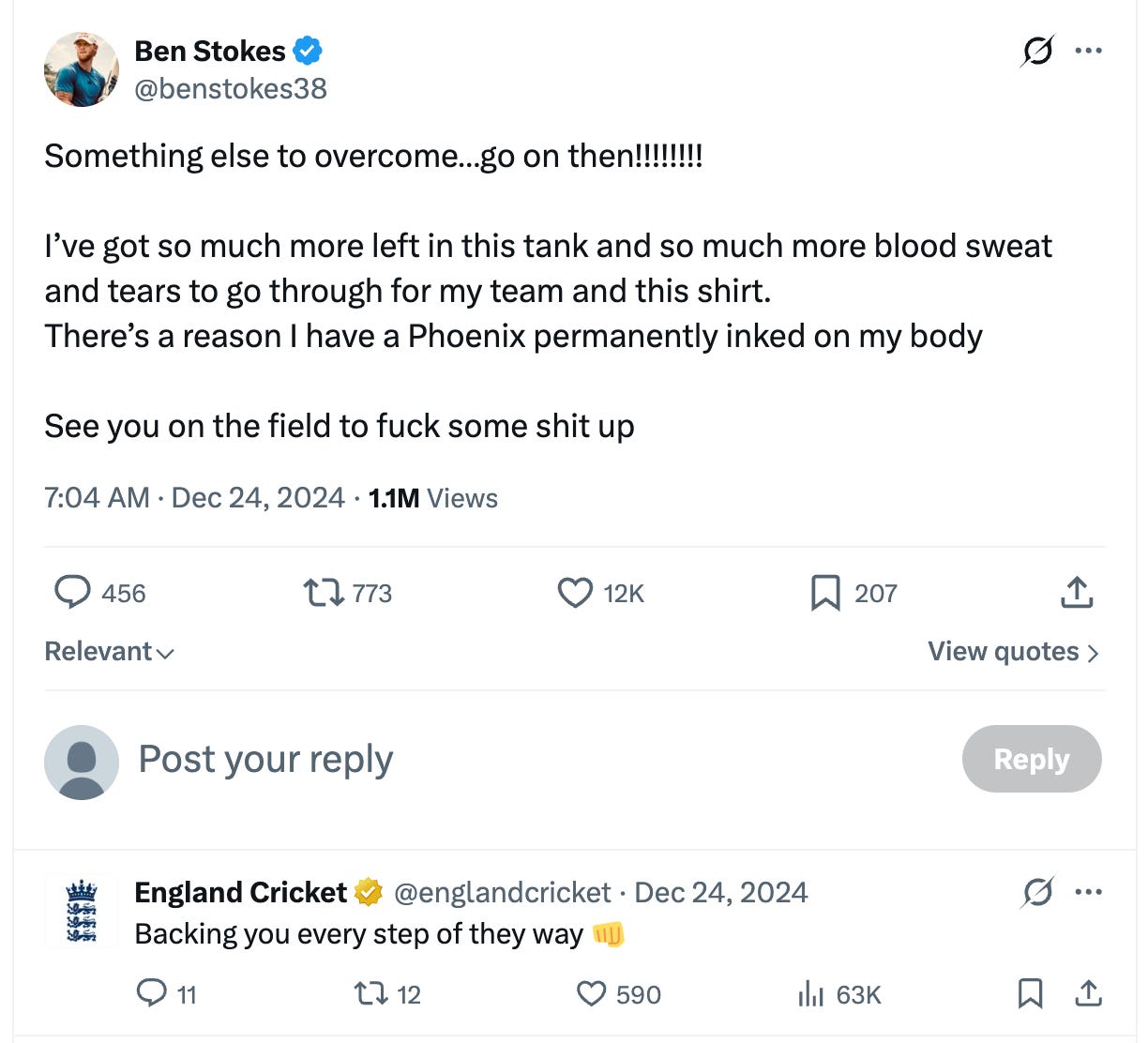
When he sustained an accidental facial injury while looking on in the nets at Durham, his first impulse was to take to social media to share it.

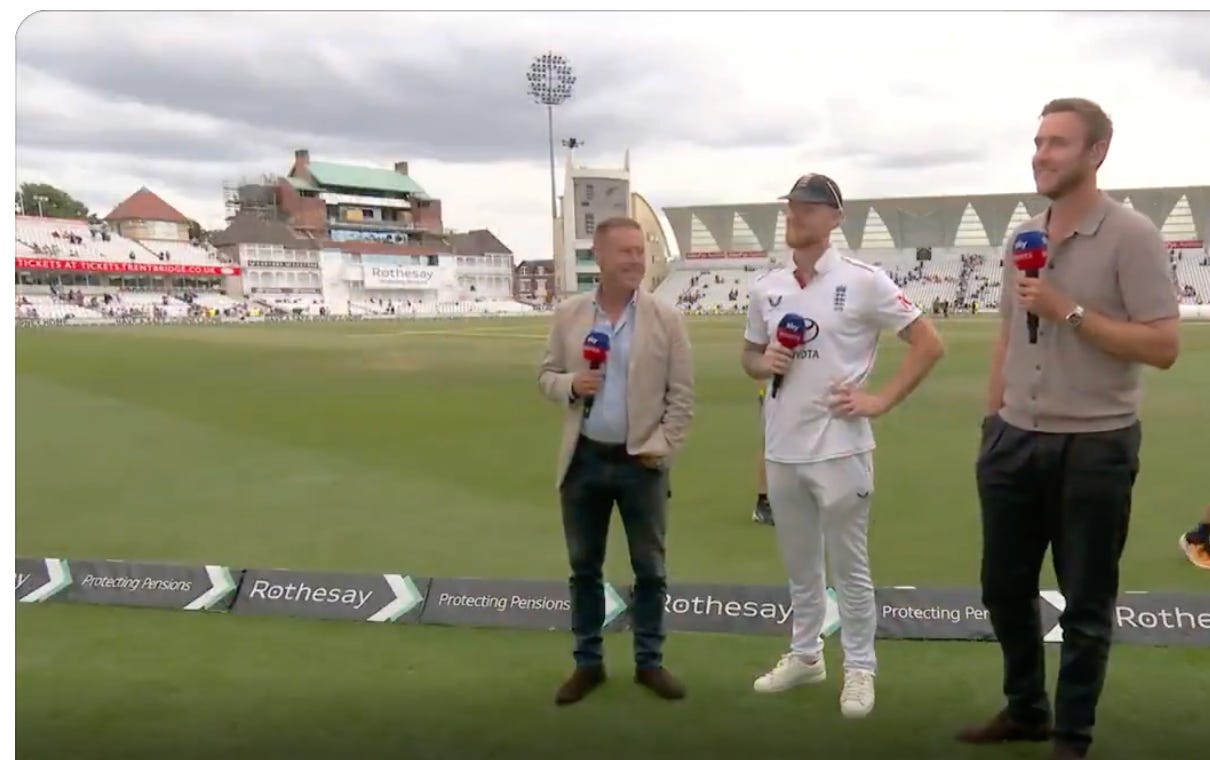
In recent years, in fact, it had even become something of a fetish, Stokes pursuing training regimes of masochistic intensity, spurred into leonine spells that eventually left his team a man down - the effect was like that of someone hurling himself against a door unaware or indifferent to it opening inwards. It could be inspiring; one wondered, at times, whether there was a degree of deliberate self-harm. Was there something of the same courting of trouble at work in Chelsea three weeks ago, having already made the decision to retire - an inner resentment of limits, a pent-up fury at ‘the suits’? This is the man who in the wake of the 2019 World Cup told a selfie-seeking ECB potentate to ‘fuck off’. Retiring in the middle of a Test is now one last reverberating middle finger to these bureaucrats with whom he had no patience - but for all the emotion of the final scenes, it also feels pointlessly destructive. Yes, a group of fans occupying a quadrant of Trent Bridge chanted Stokes’s name during a valedictory interview. But did you notice that most of the ground was empty, having watched England throw four good wickets away including Stokes’s?
The contrast with Daryl Mitchell’s flinty resistance - the kind that actually wins Tests matches - was acute. And legacy is something you leave behind, not something you take with you. While Stokes has built a great career on his own account, what has he bequeathed English cricket? As remarked, it is in disarray. His coach is discredited. His deputy is a dolt. His best friend will almost certainly be saddled with the captaincy, four years after it almost destroyed him. The test of a cricketer is not one’s own record; it is the state of the game after you have gone. For all Stokes’s barnstorming feats and magnificent moments, cricket in England looks embattled, confused, diminished - much like, ten years after its own act of deliberate and pointless self-harm, the country.
This is precisely true.
I need to start by acknowledging a truly wonderful career. He led England to white-ball trophies, and was capable of epic performances in Tests. Australians tend to think of Stokes as a good all-round cricketer; in England, he's spoken of as if he were some kind of combination of Brian Lara and Malcolm Marshall. It's impossible to exaggerate the reverence in which he's held by most English cricketers.
That has made it more difficult for people in England to evaluate his recent performances with any objectivity. It has been some years since he was a Test batsman of any consequence. In the last three years, his Test average is 26.88 (from the relative comfort of six or seven in the order). In each of England's two major series in that time, against India and Australia, he averaged 19. He has seemed, a lot of the time, to have been batting with a mind cluttered by anger. In the same period, he has often been England's best bowler, but the toll this has taken on his own body has been fearful.
But he leaves English cricket in a mess, to the point where the team needs to be rebuilt almost from scratch. There is not a single player in the Test side whom you could confidently appoint as the next leader. Cricket's convention, God knows why, is that you make the best batsman captain. Well, Root has been there and done that and isn't very keen to repeat it. So Brook? But he can't even control his own game. He's just been standing in the field watching Mitchell score 100 from 241 balls - proving, if nothing else, that batting is possible on this pitch. Someone with a bit tactical sense might think, hey, how many would I make if I bat for 241 balls? (The answer, in Brook's case, might be between 150 and 250) But no: in this team, somehow, slogging seems to be the answer to every problem. Hey guys, if we smash 100 tonight, we'll only need 270 tomorrow! Well, sure, but if you throw away four wickets tonight, New Zealand will only need six more. Duckett has played 45 Tests without ever being mentioned as a leadership candidate, Bethell is a kid who isn't sure where his off stump is, Smith is trying to find something approaching consistency...
If this is the last Bazball Test, it's a fitting epitaph. Dumb to the last. New Zealand was down to two fit seamers, and Mitchell Santner looked as though he was trying to remember how to bowl. If England had been happy to score at, say, five an over, they could have been 75 for 0 at stumps and New Zealand would have been there for the taking. Duckett, I guess, got a good ball, but his mind was scrambled by trying to alternate smashes and scoops. The other three gifted their wickets. Billy Beane's insight in Moneyball was that the most important number in baseball is three: the number of outs in an innings. In Bazball, the number of outs seemed not to matter if your strike rate was higher than the other side's.
The only good news for England is that the series they have next isn't a bad one for a side in transition. if England is in disarray, Pakistan can usually see them and raise them a crisis or two. So I suppose England puts Root back in charge, with a brief to hold things steady while England resets. Much as they will miss him, I suspect there may be players in the England side who could benefit from not playing in the atmosphere of angry intensity that seemed to surround Stokes lately. I suspect Stokes' retirement puts an end to Shoaib Bashir's Test career for now: without the all-rounder, I don't see England playing a non-batting spinner. Maybe Jordan Cox and Rehan Ahmed come in for Stokes and Bashir, and England tries to find a settled side in time for the Ashes in 12 months time. It feels, though, like there are no quick fixes.
As usual Gideon nails it! - “For all Stokes’s barnstorming feats and magnificent moments, cricket in England looks embattled, confused, diminished - much like, ten years after its own act of deliberate and pointless self-harm, the country.”