


The XXXX logos on the shirts. The Cornhill Insurance brand on the outfield. Almost everything else about about the preamble to the first ball of the twenty-eighth over of England’s first innings at Old Trafford on Friday 4 June 1993 looks like it could be unfolding in the 1960s, or even the 1930s, from the baggy green donnets to Dickie Bird’s long white coat and wintry gaze. Then, with a flash to transform sepia into technicolour, antiquity into modernity, Shane Warne delivers…..well, you know what. ‘He’s done it,’ says Richie Benaud, at his understated best.
Cricket’s paradigmatic images having tended to involve batters, it had never occurred to anyone to isolate a single delivery for distinction. And who had ever conceived of the entire twentieth century as constituting a cricket era to survey? Yet in his column in the Sunday Times, Robin Marlar rolled out a fat phrase in remarkably prophetic terms.
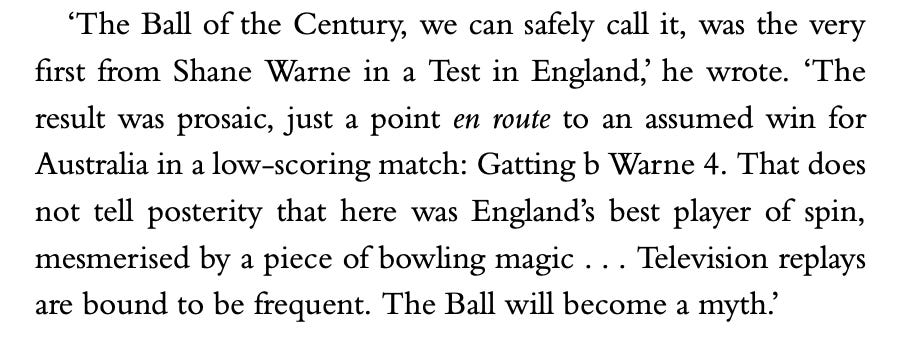
It’s worth noting a few things about this judgement, including that it did not appear until the Sunday morning, a full day and a half after the event described. Little-remembered today, ‘Snarler’ Marlar was famously peppery personality, having been a flamboyant amateur captain of Sussex whose players were said to follow him ‘out of curiosity.’ He confidently predicted in 1977 that the game would send Kerry Packer packing. He was sued by Ian Chappell for saying that Chappelli’s selection in 1980’s Centenary Test would be an ‘obscenity’. Sunday is now just a day in the sporting week; in that analog era, a columnist on Sunday had to say something not already said, to reach that little further. But the future would stretch to make good Marlar’s prophecy, mainly because Warne outstripped even the most fanciful estimations of his prowess. As Donald Sassoon has observed, the Mona Lisa owes its cultural primacy not simply to its greatness as a painting but to da Vinci’s growing reputation as a polymath: artwork and artist form a loop, amplifying the other’s renown. Bowled by anyone else, the Ball of the Century would be a self-contained curio rather than a legend; without the Ball of the Century, Warne would, if still great, be subtly diminished. There are no plans to consecrate a special subterranean chamber for the Ball of the Century, as there are for the Mona Lisa. But there is, now, a book promising to explain ‘how one delivery changed cricket.’
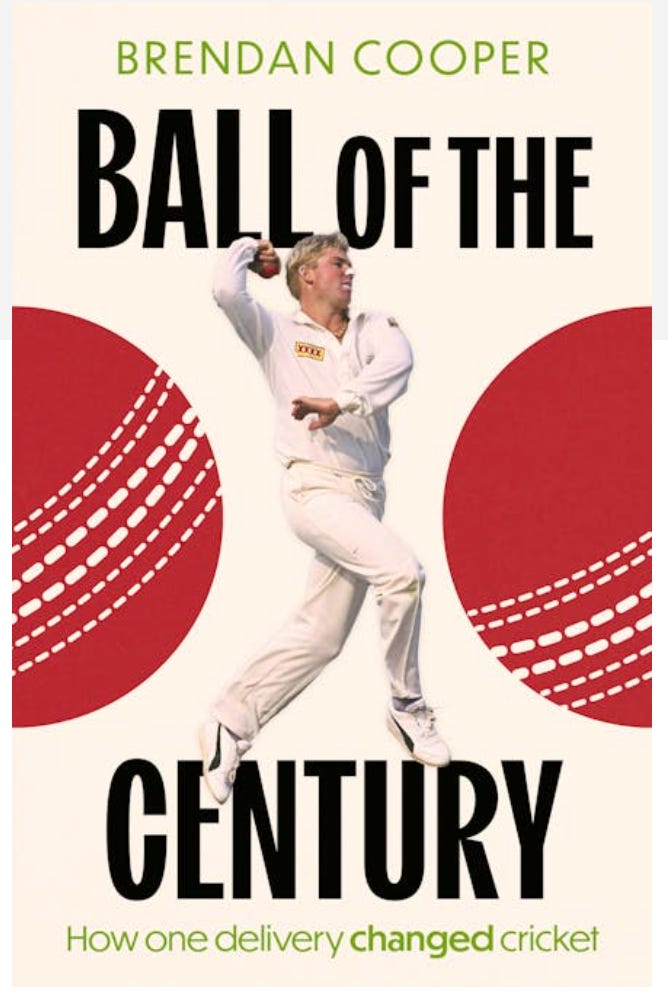
It’s by Brendan Cooper, whose Echoing Greens (2024), a richly detailed cultural history of English cricket I enjoyed as much as any cricket book this decade - honestly, do read it if you have not, it’s a tour de force. So on Ball of the Century I fell the minute it arrived, excited by the alignment of an obviously gifted writer with a transcendant subject. The excitement did not last. Cooper has managed something I did not think possible: he has rendered Shane Warne boring.