

Secrets and Lies
GH on Patrick Radden Keefe's London Falling

New Yorker’s Patrick Radden Keefe forms part of a small, and diminishing, selection of journalists who turns what they are reporting into a kind of literary event. There is the story, usually murky and morally complex. Then there is the Keefe telling of it, characteristically measured, incisive, and replete with lapidary detail. It is unfair to call it a formula, but it is a sensibility, and he has used it to stunning effect in Say Nothing (2018), Empire of Pain (2022) and The Snakehead (2023); also in the miniatures that compose Rogues (2022), a collection of his New Yorker despatches.

Keefe’s knack is for scaling great subjects down to explicably human dimensions. In Say Nothing, he interpreted the Troubles through the 1972 disappearance of Jane McConville, a mother suspected of spying by the Irish Republican Army. In Empire of Pain, he described the opioid crisis in terms of the dynamics of the Sackler family’s pharmaceutical dynasty. In The Snakehead, he illuminated human trafficking by the tangled tale of a single ship, the Golden Venture. Journalists frequently approach stories in the fashion of the blind men trying to make sense of an elephant. Keefe coolly locates that part of the elephant’s anatomy most congenial to longform story telling. Then, because he has described, say, the trunk so convincingly, he can gesture more airily to the rest of the beast in a book. His research is granular, his prose moreish, and he avoids some of the more egregious excesses of the phenomenon of journalist-as-hero by remaining slightly to one side of his stories. Mind you, profiles of him are increasingly fawning and starstruck.
He has modeled for J. Crew, appeared as himself in HBO’s “Industry,” and is, according to David Remnick, his boss for well over a decade at the New Yorker, a “relentless, relentless reporter and a storyteller of the highest order.” He is one of the last household names in nonfiction at a time when the entire future of the enterprise — writing — is up in the air.
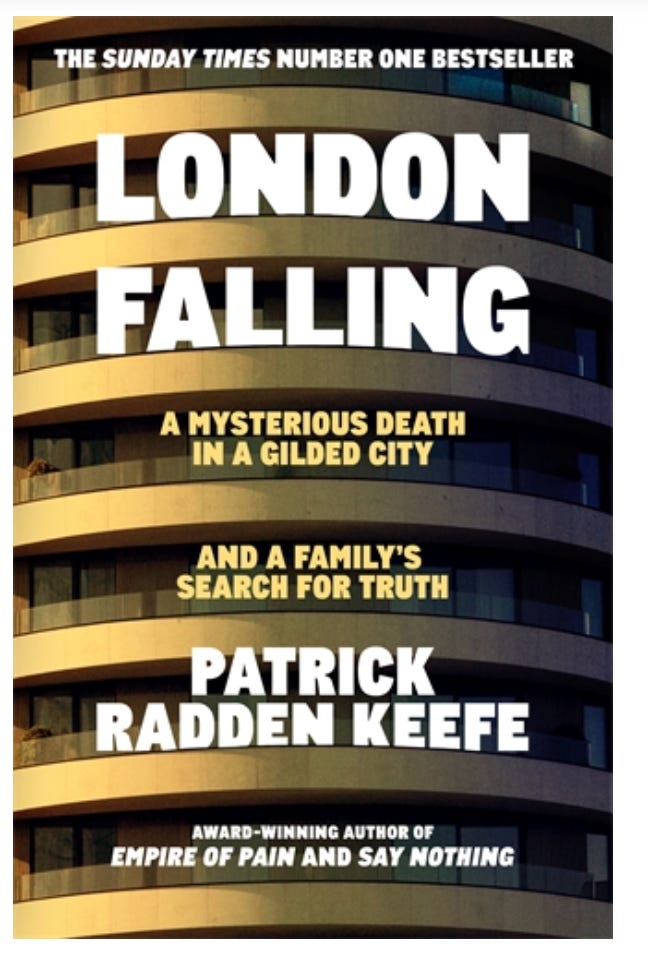
London Falling shares a similar genesis with his earlier works. Keefe first told the story of the 2019 death of a London teenager, Zac Brettler, who tumbled into the Thames from the fifth-floor balcony of a luxury Millbank apartment, in New Yorker in February 2024. The son of a well-to-do but unostentatious family from London’s genteel Maida Vale, Zac was a compulsive fabulist who had gained access to the new London overclass of fast money and easy morals with a version of the Nigerian prince scam. By posing as an oligarch’s estranged son surnamed Ismailov, he had endeared himself to two dark figures, shiny but shonky business heir Akbar Shamji and high-living gangster Verinder Sharma aka Indian Dave. He drew them on with tales of a vast but temporarily inaccessible offshore wealth; they spun reciprocal fictions until, after nine months, they lost patience and precipitated a confrontation.
When Akbar introduced Zac Ismailov, this gormless, abandoned billionaire’s boy, it must have seemed to Indian Dave like the ultimate prize. Take the kid in. Mentor him. Verinder would have known just what to do do. Play the long game. No demands up front. In fact, he could make Zac feel as if he might be the one getting the better end of the bargain: a place to stay, a powerful friend. As the police harvested the communications between Akbar and Verinder from those final days before Zac’s death, it became clear that after nearly six months of this long game, the oligarch’s son had never produced any money, and Indian Dave was growing impatient. ‘I want 5pc of that $205 million,’ Verinder told Akbar in one message. ‘I’m thinking fuck this little kid,’ he said in another. At 4.30pm on Zac’s final day Verinder texted Akbar: ‘He’s not allowed to run away now.’
As Zac’s father Matthew says to his mother Rachelle: ‘It’s like watching a crime thriller on TV, except it’s your own life.’ They are left to wonder whether their son’s fall was murder, suicide or attempted escape - the last (spoiler alert) is the conjecture Keefe prefers.
Keep reading with a 7-day free trial
Subscribe to Cricket Et Al to keep reading this post and get 7 days of free access to the full post archives.