

Wasim What Dunnit
GH on the great man's 60th birthday

Last week Wasim Akram was on the Hajj pilgrimage in Mina, part of which, the Rami al-Jamarat, requires pilgrims to cast pebbles at three stone walls or pillars, symbolising the rejection of evil and the temptations of Satan. Like his companions, he did this first with a gentle toss. Then, at once, he rocked back, and from the depths of muscle memory summoned up that powerful but effortless and unmistakeable action, following through with the pump of his left fist, as if to issue the devil a send-off.
More than twenty-three years have elapsed since Wasim last bowled in a Test match, and half the population of Pakistan is under the age of thirty. Yet the reaction was instant recognition, and social media pandemonium, almost to the point of a white ball recall against Australia.


Quiet news day, one might think, but no - there has been plenty happening in Pakistan, suddenly the diplomatic centre of south Asia. The fact is that Wasim Akram still makes waves. Today, mirabile dictu, he turns sixty, while remaining vividly relevant. When Mitchell Starc passed his wicket taking record during summer, he consented that Wasim is ‘still the pinnacle’ of bowling from the left. When Cricinfo recently fantasised of a mouth-watering cricket contest of the ages, they thought of a Super Over from Wasim to Virat. Throughout his recent trip he was swarmed by selfie seekers, including, once, while he was at prayer.
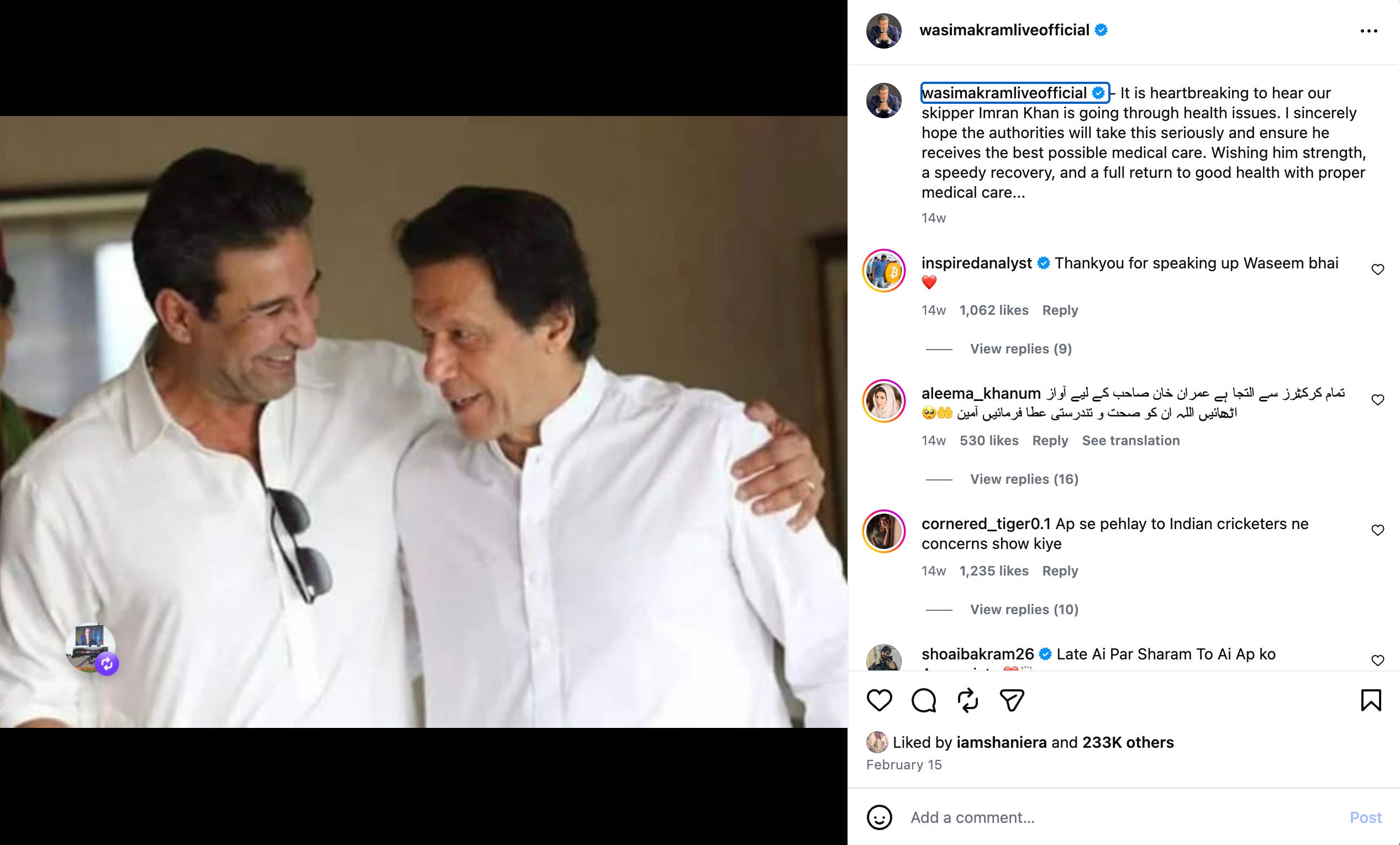
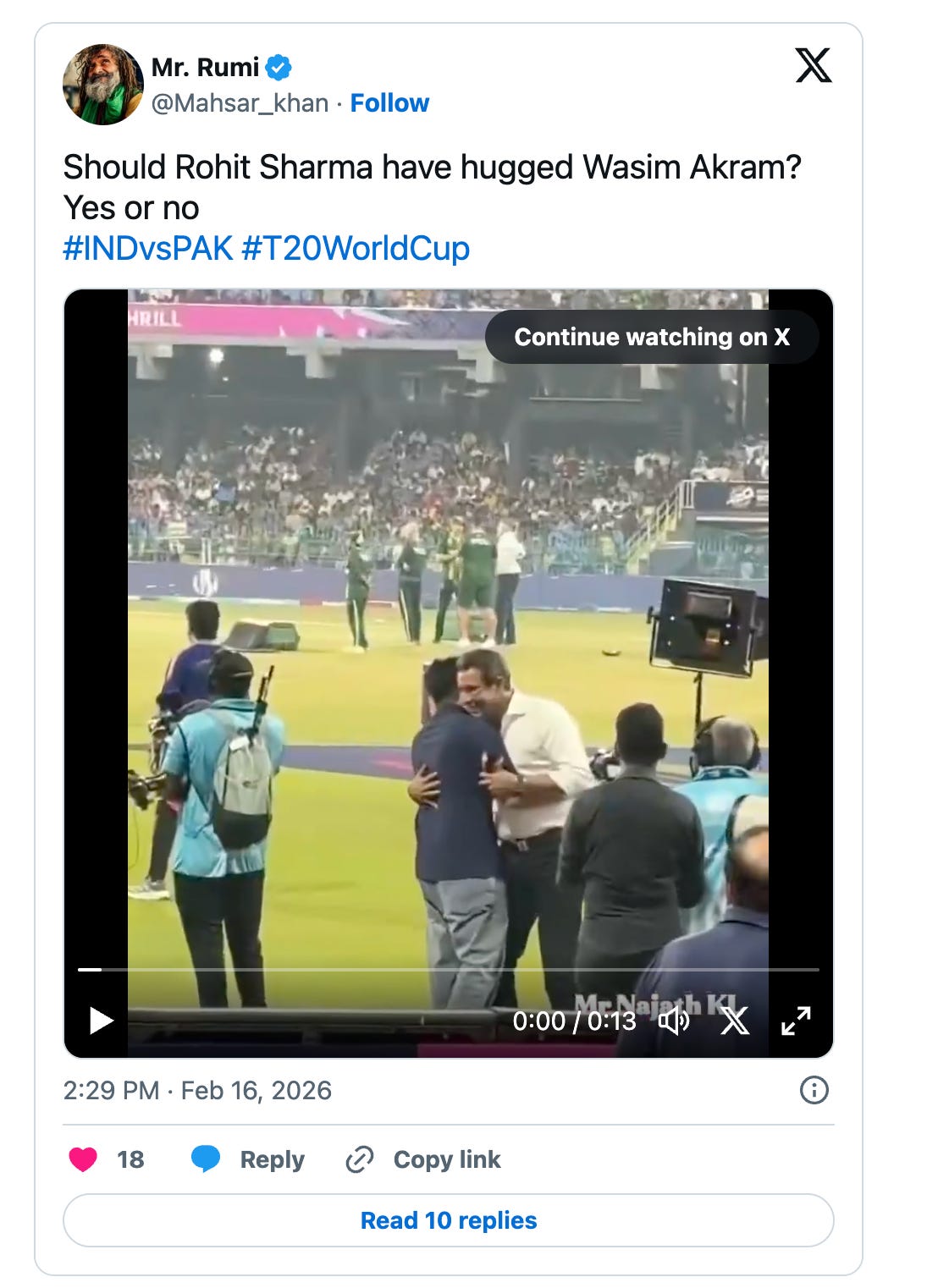
Wasim has has had to tread a delicate line where the incarceration of his former guru Imran Khan is concerned, but has sternly lamented the politics befouling Indo-Pakistan cricket relations: when their successors as captains of India and Pakistan were refusing to toss during the T20 World Cup, he thought nothing of hugging Rohit Sharma.
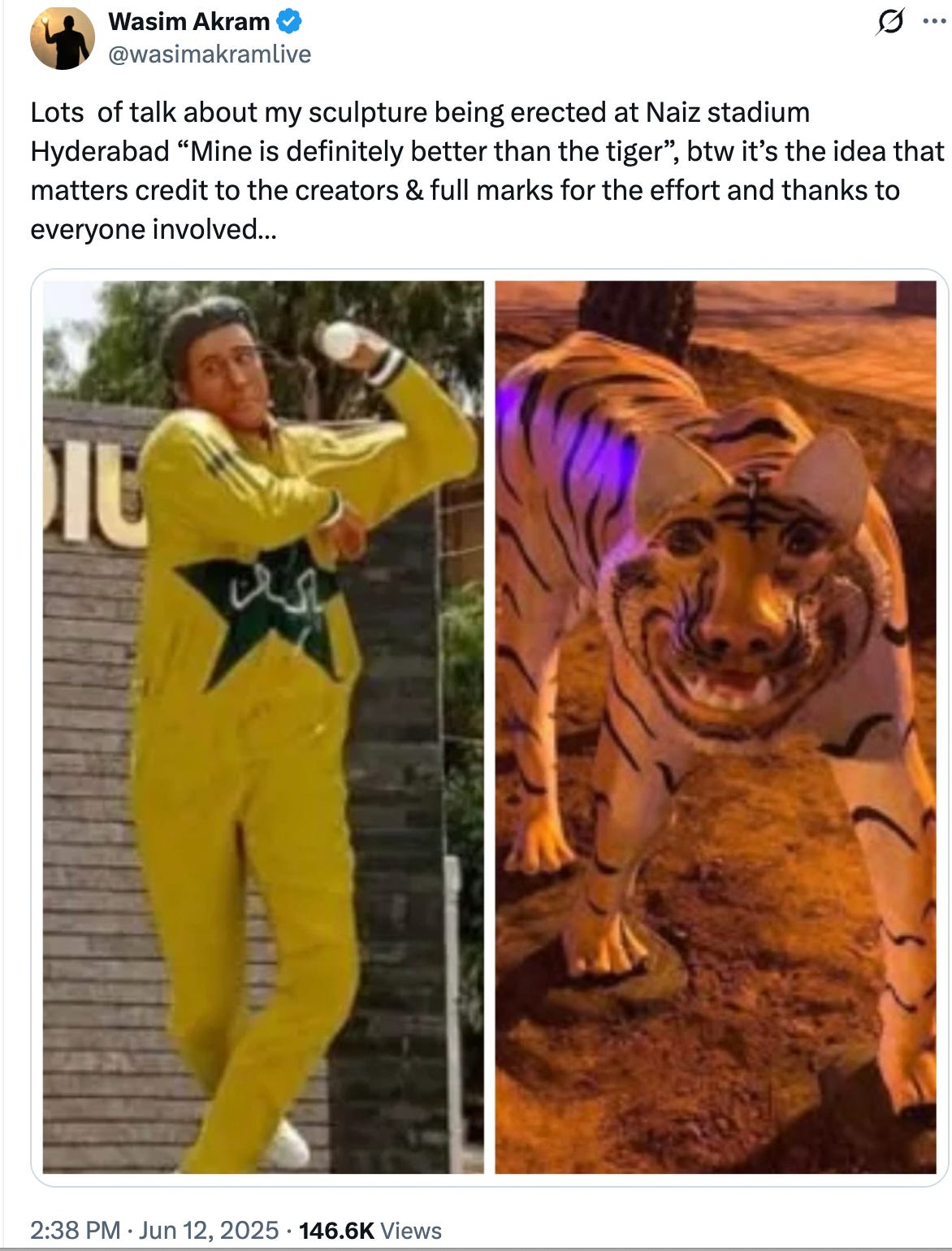
Knowing that his words are minutely scrutinised, and even recruited for fake news, has not caused Wasim to court popularity: he irked Indians by saying he found the IPL ‘boring’; he perplexed Pakistanis by praising Bangladesh’s pitches and panache during their recent series victory; he even graciously defended the artist whose statue of him at Niaz Stadium was widely ridiculed on its unveiling last year.
There may not, in short, be a cricket presence quite like him, partly because no cricketer in his country has come along to shove him aside, while his great Indian contemporary Tendulkar has been succeeded by Virat, Rohit, Bumrah, Jadeja, Ashwin, Sooryavanshi et al, and partly because he personifies a halcyon period in cricket when every nation was genuinely competitive, compared to a present when the big three suit themselves, the calendar is chaos, and money drives everything. A white ball encounter between Pakistan and Australia would once have been marquee - now, thanks to decades of maladministration and greed, it is a squib, a dwindling nation versus a second XI.
Plus, and this ain’t nothing, Wasim still looks incredible, am I right?

No disrespect to, for example, Saeed Anwar, but to Wasim bhai the years have been kinder.

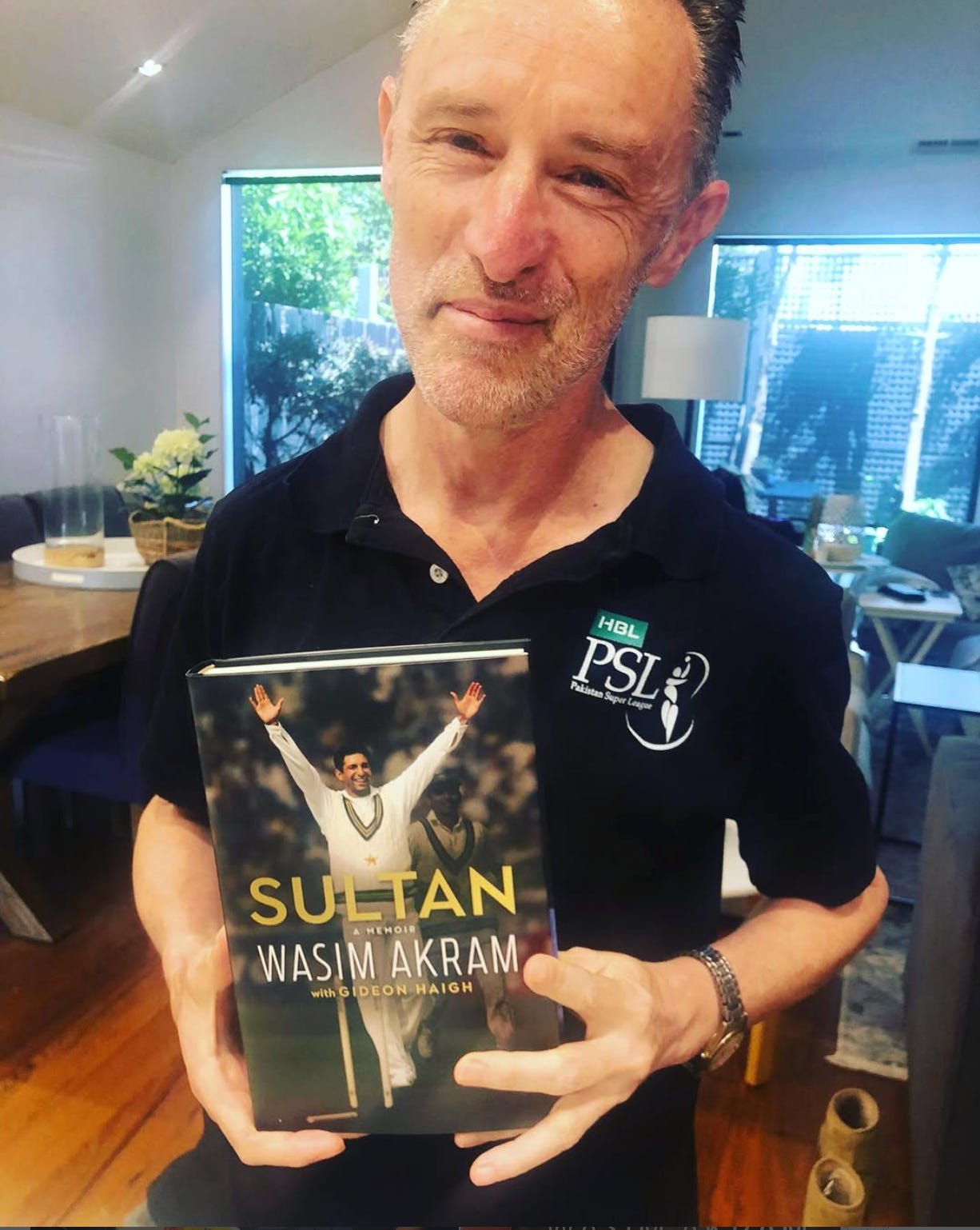
I should, of course, acknowledge some personal bias, in that a few years ago I helped Wasim tell his life story, had the opportunity to spend many enjoyable hours in his company, and found him exactly as one would wish - warm, hospitable, cooperative and candid through a process with many complications, not least COVID.
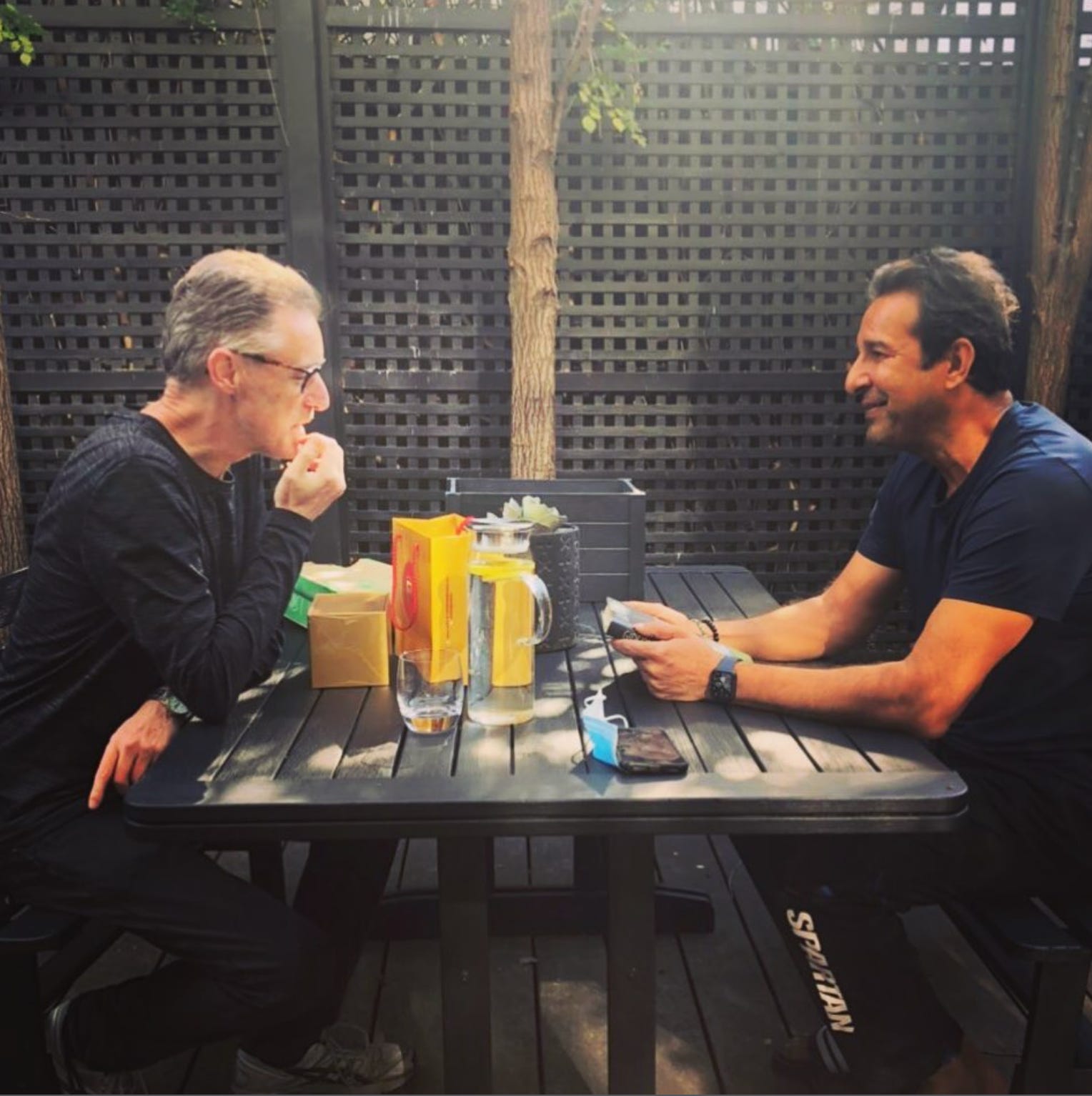
Wasim is not an egocentric man, and disinclined to centre himself in stories; nor did the kind of stillness necessary to recollect and reflect come naturally to someone of restless physicality. It was a unusual exercise, in that the bulk of the book referred to cricket played long before. Most sporting autographies are composed off the back of a retirement announcement; Wasim had waited twenty years. It was, in the end, better for that, if still not easy.
Analysing cricket greatness is an endless weighing of nature and nurture. When I spoke to Imran, he was absolutely adamant: he had never encountered a cricketer so naturally gifted as Wasim. For his own part, Imran did not regard himself as talented, thought he had to work for everything in cricket. But in Wasim, this perfect physical specimen, it was as though the cricket already brimmed over - all it needed was direction, channelling, and harnessing to an ethic of uncompromising dedication and competitiveness.
The great challenge for Wasim was reorienting himself when Imran retired. Wasim was promoted as his successor, in a dressing room seething with jealousy, in the conspiratorial culture of a politicised administration. Imran had shielded him from this; now Wasim, still only in his mid-twenties, had no protector, a host of ambitious rivals, and many temporary ‘friends’. Yet how he bowled, and it still takes your breath away, doesn’t it? Tell me that the ball to bowl Dravid isn’t a ball of the century candidate….
Speaking of which, it’s instructive, I think, to parallel Wasim with his good mate Warnie: both generational cricketers; both Brighton residents; both St Kilda supporters! Both have suffered through controversies - real red-blooded controversies, too, not the wishy-washy, handbags-at-dawn, social media spats of today, but around issues of cheating and corruption, in Warnie’s case carnality, and in Wasim’s addiction. By outlasting these travails in the public eye, I think both men stepped their fame to subtly different levels, where it was enriched by the quality of resilience - the sense that they had succeeded in the scenarios when it mattered, and that everything else was ultimately noise. In doing so, they enabled us to see sport in proportion. Nobody died, the sun rose on the morrow, and cricket, for all its problems, remained the greatest thing God created on earth. Warnie, alas, is no longer with us. But Wasim lives, Wasim prospers, and they’re still coming out beautifully.
Writing worthy of the man and the player. Lovely, Gideon.
And he got 269 in a Test batting at 8!