

What Happens Next at the State Library of Victoria?
GH has an update

They’re clearly not superstitious at the State Library of Victoria. Christine Christian’s board chose Friday the 13th to confirm weeks of rumour - that they’ve retained Korn Ferry to help recruit a new chief executive officer, seven months after the retirement of predecessor Paul Duldig and the promotion of caretaker John Wicks. Let’s hope it goes better than last time, when they ended up with Duldig after their first choice, a Briton, and their second, an Australian-raised American, ruled themselves out, an excellent internal candidate having been overlooked. But, y’know, we must undertake the pretentious ritual of searching the world as though we’re the directors of Berkshire Hathaway, mustn’t we?

The job advertisement is somewhat confusing. Take, for example, this:
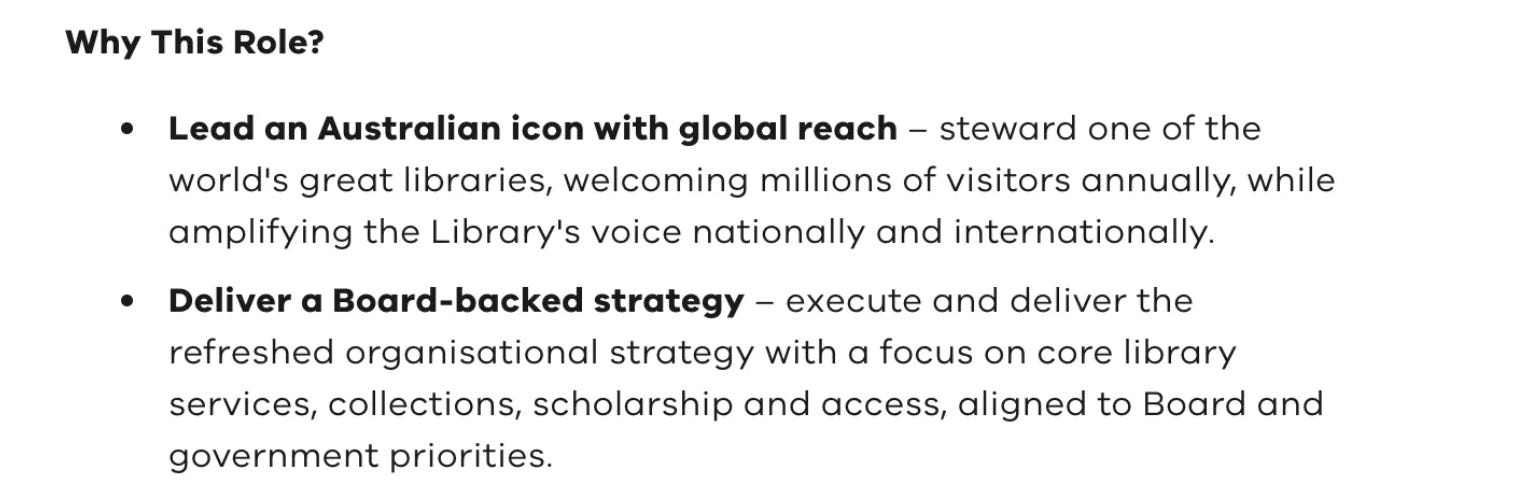
I know: still labouring the iconicism of the iconic icon, eh? But you’ll also notice that the Strategic Reorganisation Change Proposal which detonated in the library’s face is now redefined so that the ‘focus’ falls on ‘core library services, collections, scholarship and access’. Amazeballs! Because, if you recall, the strategy previously accentuated ‘immersive cultural experiences’ and ‘compelling digital experience’, complete with dead-on-arrival sentences such as these:
Along with the rapid pace of technological change, we need to be flexible and creative, developing more streamlined ways of working to deliver the greatest impact for our communities….The Library recognises that to be a digital-first organisation in the fast-paced digital economy, we must invest in digital skills and capabilities.
Phew! Can the strategy really have been so ‘refreshed’ that it’s now something else entirely? Probably not - likelier it simply heralds a less overt, more piecemeal approach to the same overall end. Whatever the case, one also wonders exactly what a potential CEO would think of stepping in to implement a strategy already formulated, strongly resisted and temporarily stymied, at an institution with a demoralised workforce and damaged reputation, whose wholesale corporatisation has even extended to killing off one of Melbourne’s favourite cafes. If you’re following this from the UK, for example, you’ve probably already read last month’s take in the Times Literary Supplement.
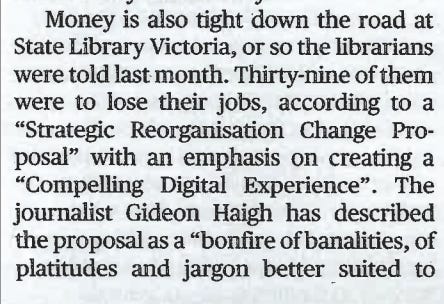
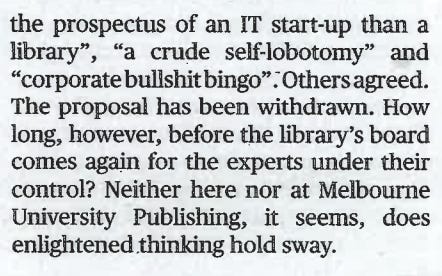
Nor will any new appointee enjoy the opportunity to choose their head of collections. Because ten months after the abrupt end of Monika Szunejko’s brief period in charge, the library yesterday made an appointment to what’s arguably its paramount role. Bear with me here.
One of Duldig’s last acts was to replace Szunejko pro tem with his former ANU colleague Roxanne Missingham, a self-described ‘retired university librarian’, on a part-time, fly-in/fly-out basis while the job was advertised - a process that finally petered out, leaving this melancholy remnant.

Now Missingham herself has taken the job. What’s more, the library has revived for her the title ‘chief librarian’, which it abandoned on appointing its inaugural CEO in 2015, and which purportedly ‘reflects the Library’s strong commitment to professional librarian leadership’. To which I call bullshit. The library’s board, as Judith Brett has observed, remains largely devoid of ‘anyone whose lifeblood is reading and writing’; the library’s senior management isn’t much better. Just because you claim a ‘strong commitment’ doesn’t make it so. But wait, Wicks has more:
Roxanne’s appointment follows a comprehensive and competitive global search, with the role advertised both nationally and internationally. The process attracted outstanding candidates from across the sector and beyond and was conducted with the rigour expected of a senior executive appointment.
Now, wouldn’t rigour in such a process be assumed? Why would you feel the need to state it at all? Why were none of these ‘outstanding candidates from across the sector and beyond’ outstanding enough? Or is this a way of addressing Missingham having herself reportedly been part of the selection panel for the ‘comprehensive and competitive global search’ that yielded no acceptable candidate and thereby left the vacancy she’s just filled? Suffice to say that on the library floor, this appointment is going down like a cup of cold sick. I dare say Missingham will also now persist with her misconceived scheme for automated ordering of heritage materials - a scheme simultaneously poorer for users and more time consuming for staff. Apart from this, of course, it’s brilliant….
So, yes, it would be interesting to know more about how Christian’s board arrives at its senior appointments. But, well, good luck with that too. I was favoured last week by shadow arts minister David Davis with the fruits of an FOI search of the library board minutes of the last couple of years. Here they are.

Ooops, sorry, that’s the Epstein Files. Here are some State Library board minutes.

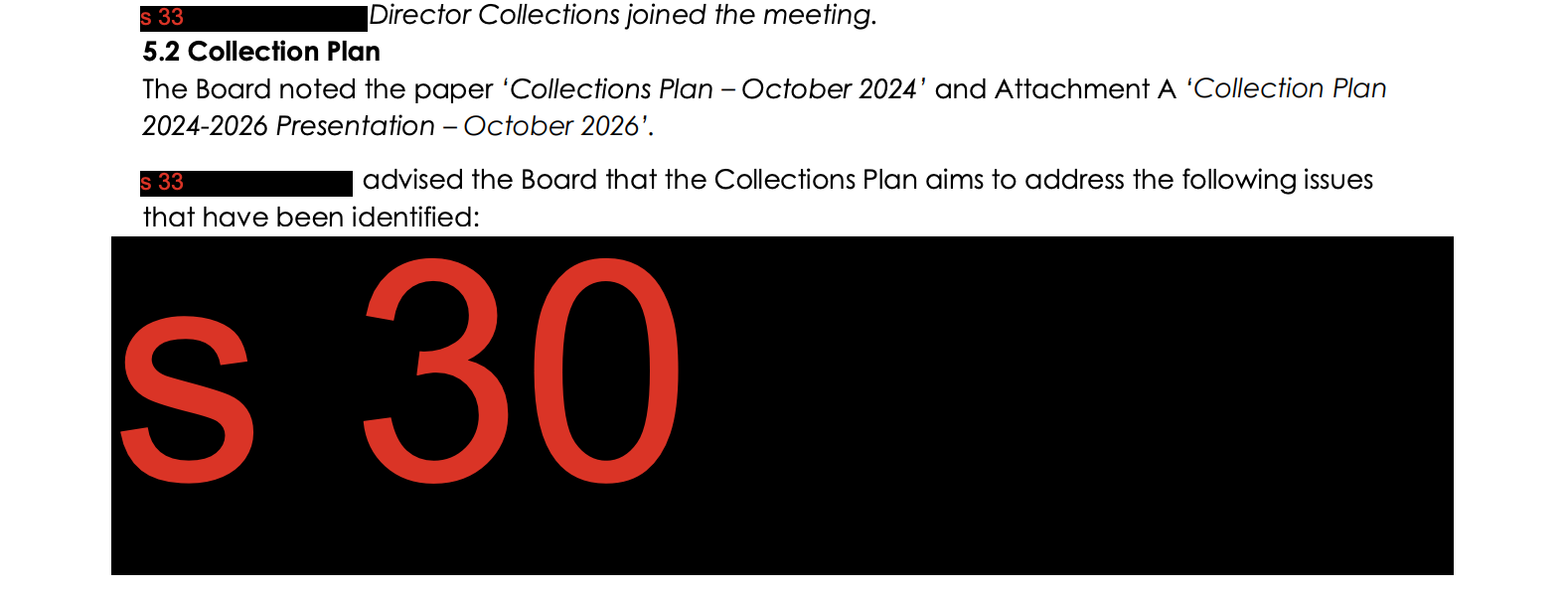
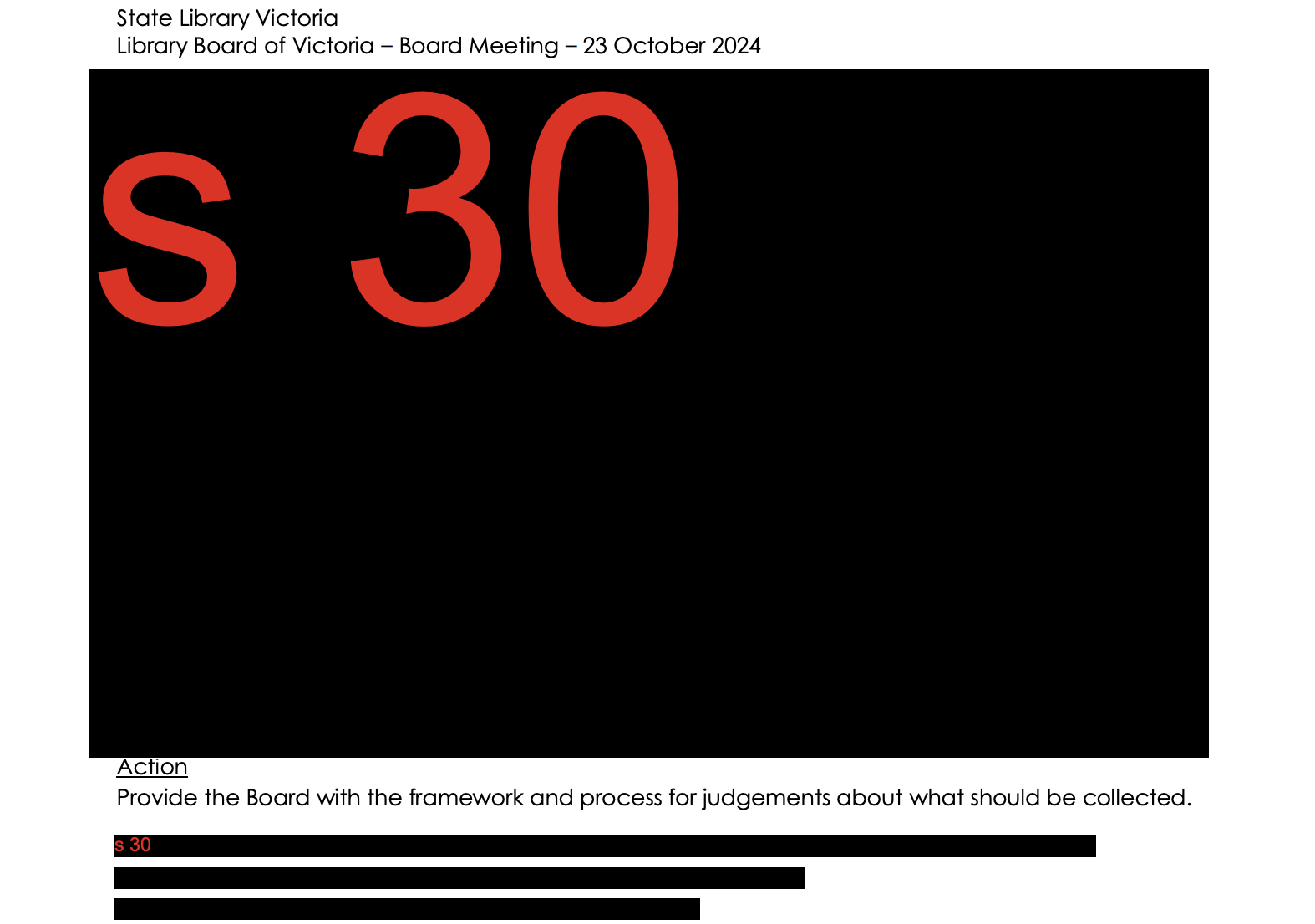
Section 30 of Victoria’s 1982 Freedom of Information Act is the one exempting documents whose disclosure would be ‘contrary to the public interest’, and, believe me, it gets a solid workout in this tranche. You wouldn’t, for example, have thought a library collections plan was such hot stuff it needed this level of redaction….
…or that a people plan was so controversial as to necessitate this….
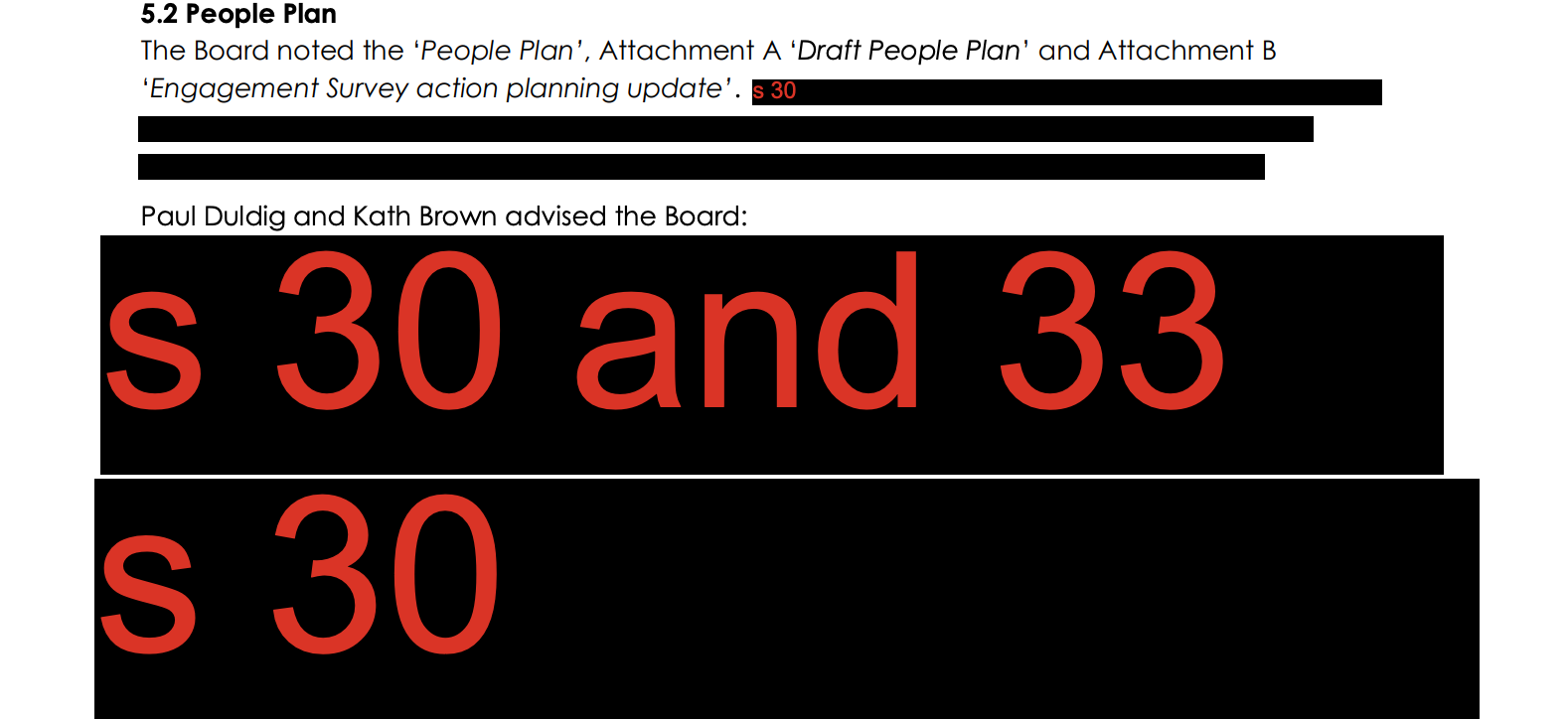
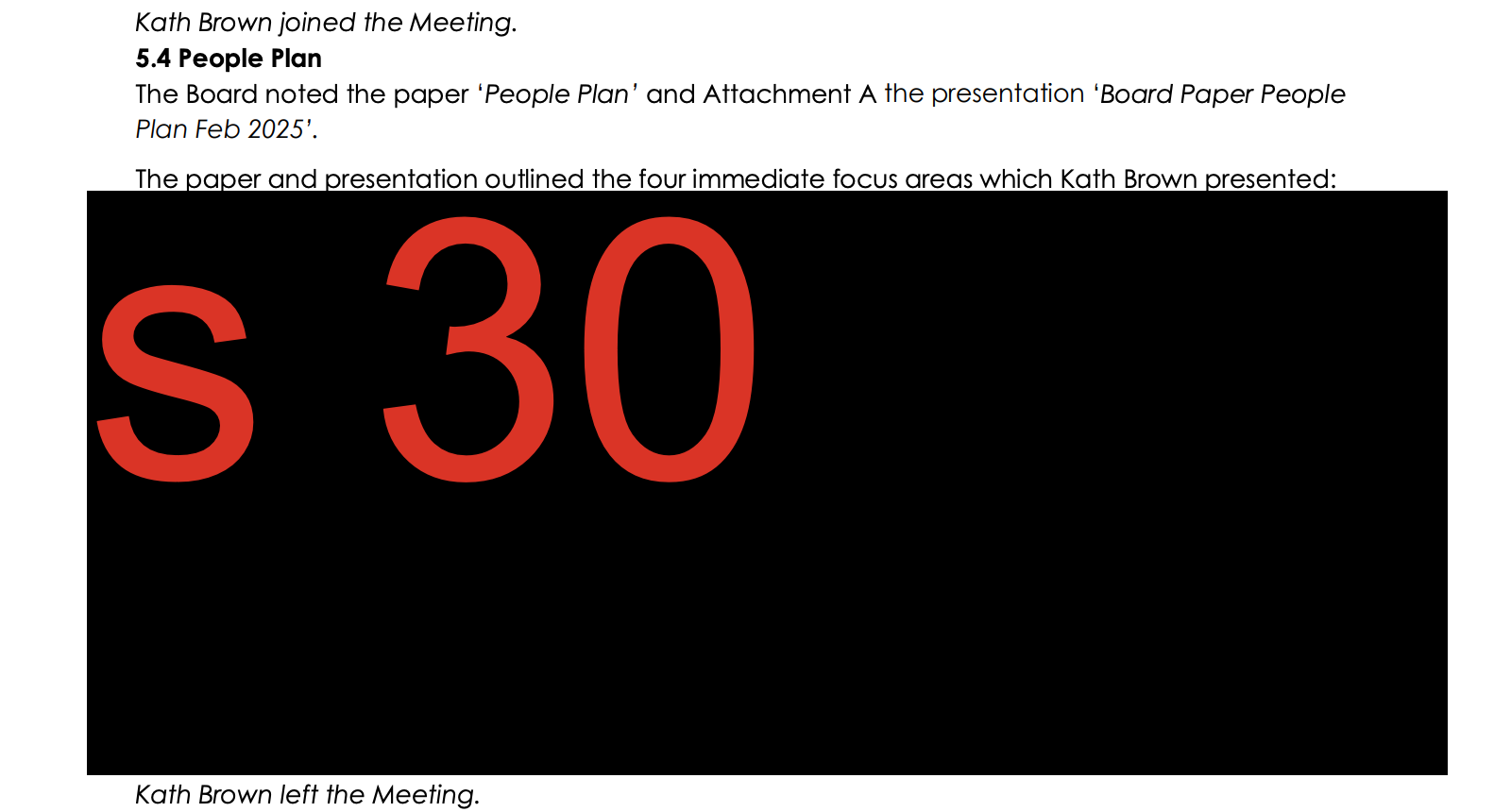
Kath Brown, by the way, is none-too-popular head of ‘people and culture’ in the van of the Strategic Reorganisation Change Proposal, whose aim was this….

…and, errr, this.
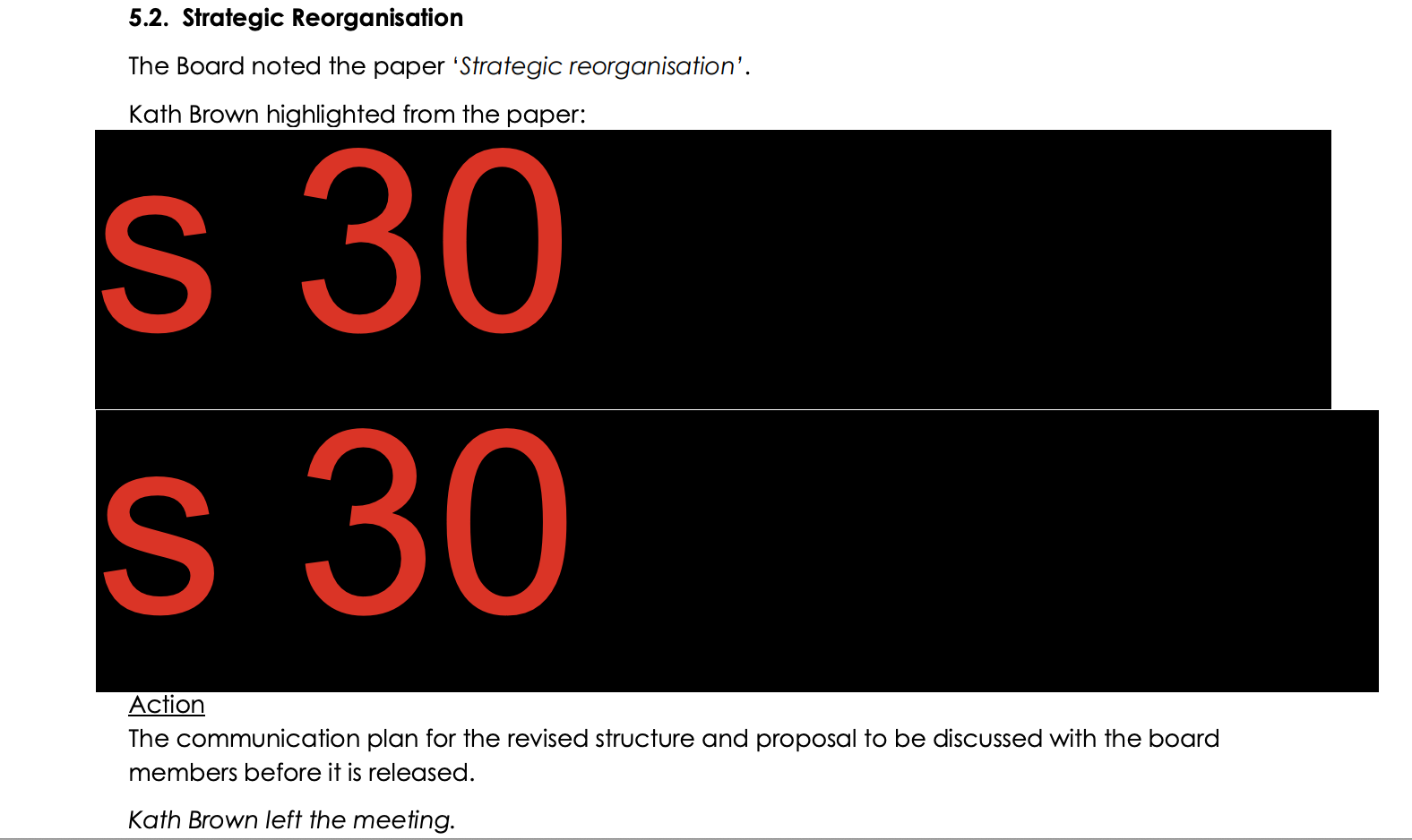
Sometimes, the opacity is unintentionally comedic….
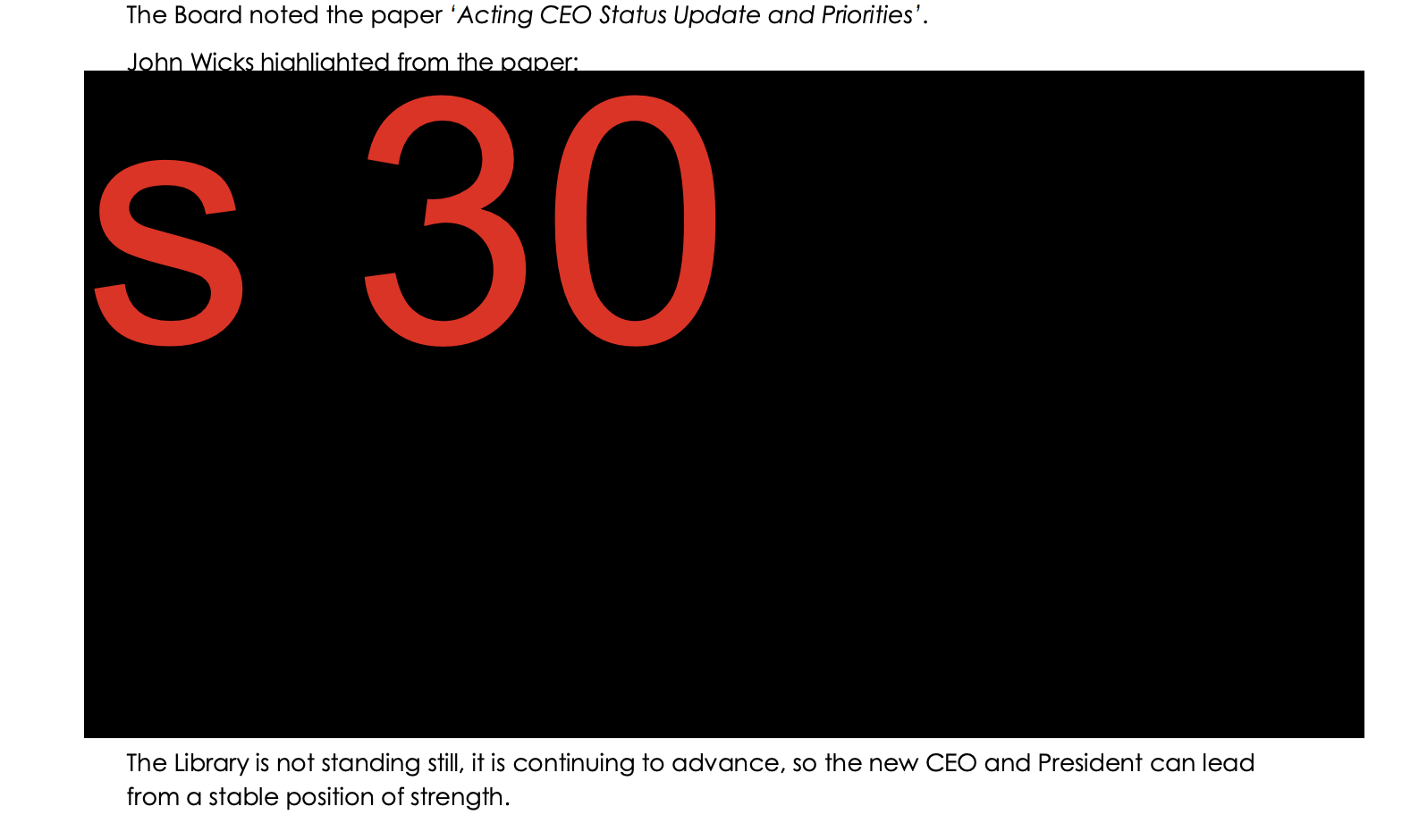
Gee, I’m glad we got to read to last bit because it can be hard to continue to advance while standing still, and also to be stable while not standing still. And who knew that the library’s ‘contribution’ needed such delicate handling?
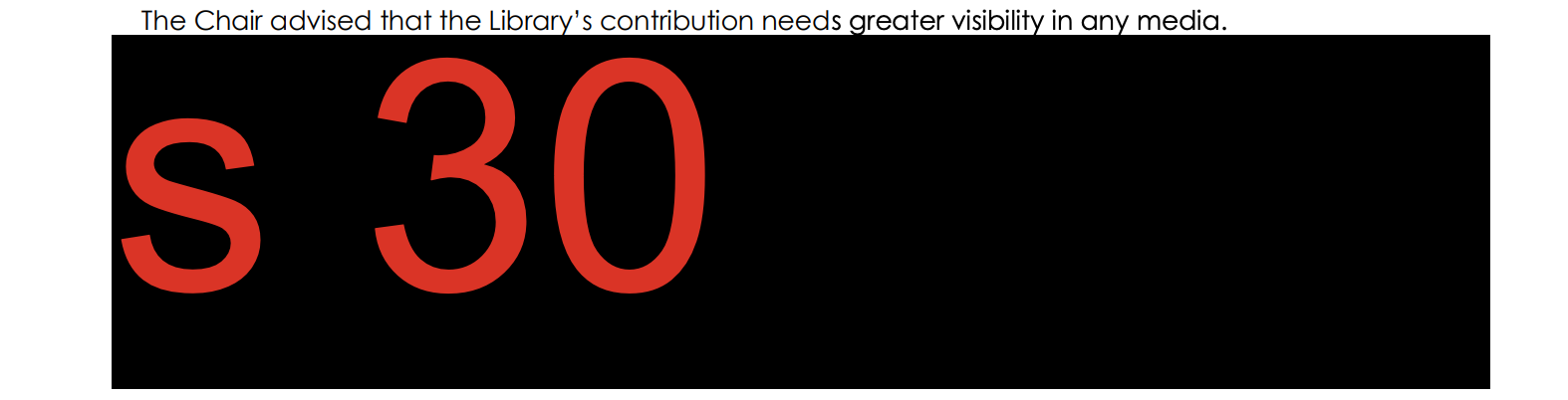
In some ways, this is par for the course in Victoria, where freedom of information is a dead letter. But it’s not out of keeping with a board already repeatedly disposed to….





Indeed, it would appear that hardly a meeting of the library board proceeds without being prefaced by an unminuted ‘in camera’ session of half an hour or more. Now, just so we’re clear, ‘in camera’ board proceedings are perfectly allowable in certain circumstances, and minute taking discretionary - so advises the Australian Institute of Company Directors.
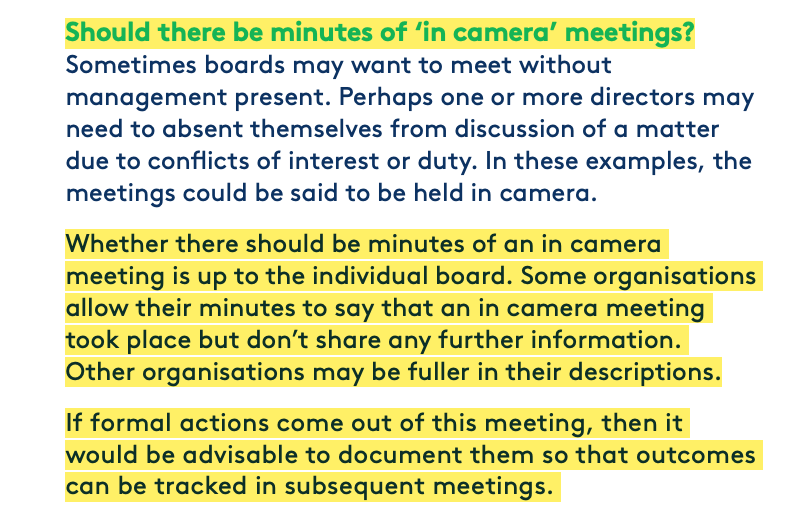
But a lay person might be left wondering: why does the board of a public-facing statutory authority founded on democratic principles and dedicated to the promulgation of knowledge have such regular recourse to confidential sessions for reasons never specified? We know they’re not superstitious. But could they afford to be a little more…transparent?
That FOI result is a goddamn disgrace.
You appear to be a lone voice on this subject, Gideon. Please keep writing about it.
This is right in line with the NSW Ministry of Arts deciding that grant recipients should be kept anonymous to preserve their 'privacy'. It's commonplace now that public bodies believe they have the right to conceal all their deliberations and decisions from the taxpayers who fund them. This represents the privatisation - or perhaps the cronyisation - of the public sphere.